
“This is a small business… I don’t need cyber insurance.”
Cyber Risks can impact all size and types of business.
John Flanagan
5/21/20263 min read
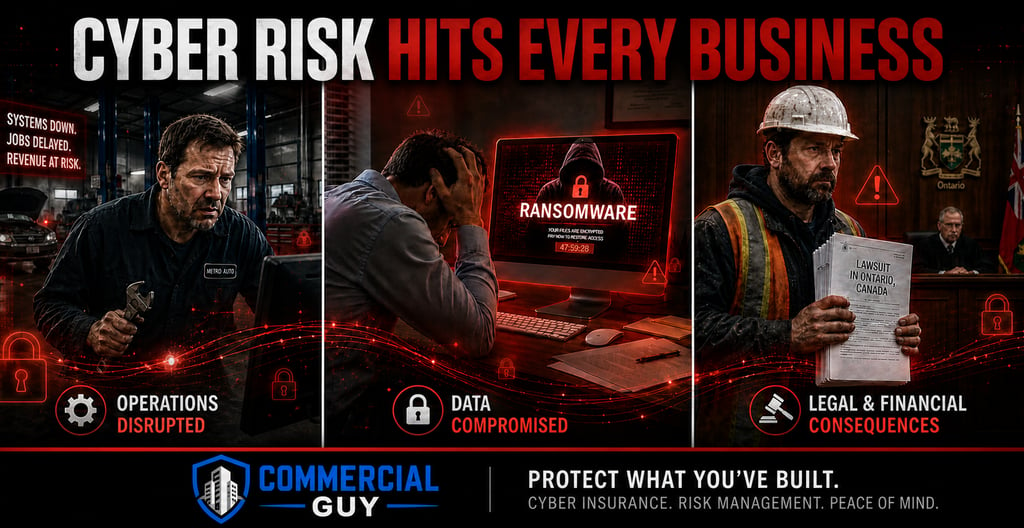
“This is a small business… I don’t need cyber insurance.”
It’s one of the most common assumptions I hear—and one of the most dangerous.
Let’s start with a simple reality: if your business uses email, uploads files, downloads documents, logs into supplier portals, or stores customer information… you are exposed to cyber risk. That applies to almost every small-to-medium business today, from contractors and retailers to professional offices and yes—garages.
Cyber risk isn’t about the type of business you run. It’s about how you operate.
Where the Real Risk Happens
Most small businesses interact digitally every day:
Uploading invoices to supplier or vendor portals
Downloading documents, work orders, or parts lists
Sending files to customers or third parties
Accessing cloud-based accounting, CRM, or management systems
Now here’s the part many business owners don’t consider:
If your system is compromised—even unknowingly—and you upload an infected file to a supplier’s portal, you could be the source of a much larger breach.
That’s no longer just your problem. That becomes a liability problem.
The Odds Are Not in Your Favor
Recent data continues to show that roughly 4 out of 5 businesses will experience some form of cyber incident within a 12-month period.
Put that into perspective:
Look at five businesses on your street. Statistically, four of them will deal with a cyber event this year.
It may not always make headlines, but it happens constantly:
Phishing emails that look legitimate
Infected attachments from trusted contacts
Compromised software or vendor systems
Weak passwords or reused credentials
And increasingly, attacks are automated. You are not being “targeted”—you are being scanned.
The Cost of a Breach
The average cost per compromised record in Canada is estimated at over $200.
If your business has:
250 client records → $50,000+ exposure
500 records → $100,000+
1,000 records → $200,000+
And those records don’t have to be complex. Names, emails, addresses, vehicle information, or payment data all count.
Under Canadian privacy laws, you are required to:
Notify affected clients
Report the breach to the Office of the Privacy Commissioner of Canada
Maintain documentation of the incident
Failure to do so can result in penalties of up to $100,000, not including legal or reputational costs.
Ransomware: The Operational Shutdown
Now consider a different scenario.
Your system is locked. Completely.
A ransomware message appears demanding payment—often in cryptocurrency. While the average ransom for small businesses has fluctuated, the real cost isn’t just the payment.
It’s the downtime.
No access to customer files
No invoicing
No scheduling
No operations
For a garage, that means bays sitting empty.
For an office, that means business stops entirely.
And recovery isn’t as simple as “restoring a backup.” Many backups are compromised or outdated.
Where Insurance Actually Comes In
Here’s where most policies fall short.
Many small businesses have a cyber “add-on” or endorsement attached to their commercial general liability (CGL) policy. These typically focus on limited first-party coverage—and often with low limits.
That is not the same as a standalone cyber policy.
To understand the gap, you need to understand two key components:
First-Party Coverage (Your Losses)
This covers direct losses to your business, such as:
Data recovery and system restoration
Business interruption from downtime
Ransomware payments (where legally permitted)
Breach response costs (forensics, notification, credit monitoring)
Most basic endorsements may include some of this—but often with restrictive limits and minimal support services.
Third-Party Coverage (Your Liability)
This is where the real exposure often lies—and where endorsements usually fall short.
Third-party coverage responds when others hold you responsible, including:
A client whose data you lost or exposed
A supplier whose system was compromised through your access
Regulatory investigations and legal defense
Fines and penalties (where insurable)
Claims arising from transmitting malware or a virus
Example:
You unknowingly upload an infected file to a supplier portal. That file creates a backdoor into their system, leading to a larger breach.
They trace it back to your business.
Now you are facing a liability claim—not just your own recovery costs.
Without proper third-party cyber coverage, that claim likely falls outside your general liability policy.
Why This Matters for Garages Too
Garages today are highly digital:
Customer records and vehicle histories
Payment processing systems
Diagnostic software connected to manufacturers
Parts ordering platforms and vendor portals
You are not just turning wrenches—you are managing data.
That makes you just as exposed as any office-based business.
The Bottom Line
Cyber incidents will happen—with or without insurance.
The question is not whether you can prevent every breach. You can’t.
The question is:
Do you have the support, coverage, and expertise in place to respond when it happens?
Because when it does, you are not just dealing with IT issues—you are dealing with legal, financial, and reputational consequences.
And those can impact a business far more than the initial breach itself.